
Gate Openers in Bloomington
Automatic operators for swing and slide gates, installed, replaced and serviced, with the safety sensors set and tested.
An automatic gate is two machines working together: the gate itself and the operator that moves it. We install operators on new and existing gates, replace worn ones and repair those that stall in the cold, reverse for no clear reason or stop answering the remote. Before an operator goes on, the gate has to move freely by hand; a stiff hinge or a dragging leaf is the most common reason openers fail early.
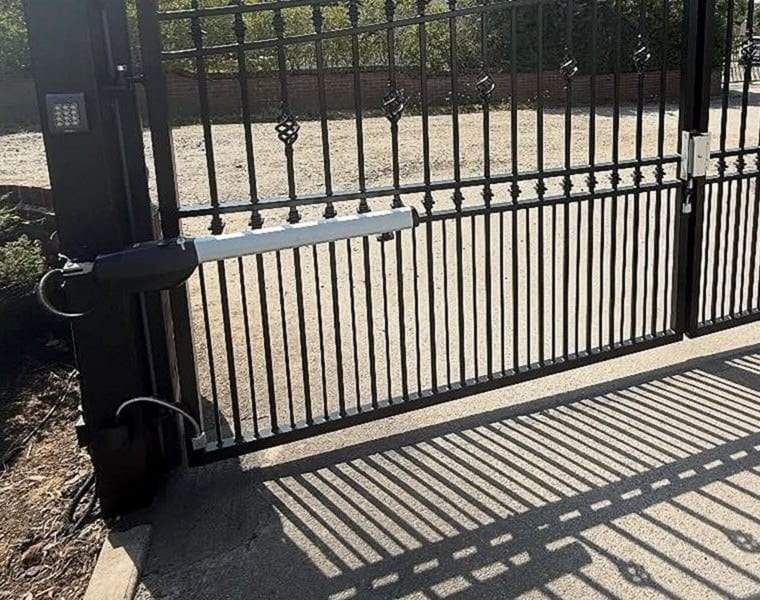
Types of Gate Operators
| Operator type | Power source | Suited gate weight and length | Usage level |
|---|---|---|---|
| Swing arm or linear | Hardwired or solar, with battery backup | Leaves up to about 16 ft and several hundred pounds each; heavier with a heavy-duty unit | Homes and light shared use |
| Underground swing | Hardwired | Leaves up to about 12 to 14 ft; the motor sits in a box below the hinge | Homes where the look matters; needs good drainage |
| Slide | Hardwired, or solar for light use | From light residential gates to well over 1,000 lb on heavy units | Homes to busy commercial entries |
| Overhead or cantilever | Hardwired | Long, heavy gates with no ground track; the operator drives the frame on roller posts | Commercial lots and loading areas |
Weight and length limits differ by model, so the figures above are a starting point. The gate’s real weight, its wind load and how often it runs decide the final choice.
Size an Opener for Your Gate
Opener Sizing Guide
Enter rough numbers. The guide gives an operator class and a UL 325 usage class to talk through with us, not a final pick.
Enter the gate details and press the button.
A double gate counts each leaf’s width and weight on its own operator.
Solar or Hardwired Power
Solar operators save running a trench for power, which matters on a long driveway. Hardwired operators are steadier when the gate is heavy or busy. The deciding factor here is winter: in December the Twin Cities get under nine hours of daylight with the sun low in the south, and a panel under snow or in the shade of trees collects little of it. A solar gate that works well in July can run its battery flat in a cold week of January.
- Solar fits a light residential gate with a few cycles a day, a panel facing south with clear winter sun, and someone to brush snow off it.
- Hardwired fits heavy gates, association and commercial entries, shaded sites and any gate that must open on the coldest mornings.
- Either way, a battery backup keeps the gate usable through a power outage.
Safety Features Every Operator Needs
Gate operators sold in the United States are built to UL 325, the safety standard for gate operators, and gates meant for automation to ASTM F2200. In practice that means:
- Photo eyes across the gate’s path that stop or reverse it when the beam is broken.
- Edge sensors on the leading edge that reverse the gate on contact.
- Auto-reverse when the operator meets resistance it should not.
- A manual release so the gate can be opened by hand without power.
- Battery backup so the gate keeps working, and stays controllable, in an outage.
Our gate opener stopped responding to the remotes. The tech went through it step by step and found a corroded wire at the control board. Fixed that and tested everything. He also pointed out the battery backup was nearly dead, so I ordered a new one. Good at explaining what he was looking at without talking down to me.
A Slide Gate Operator
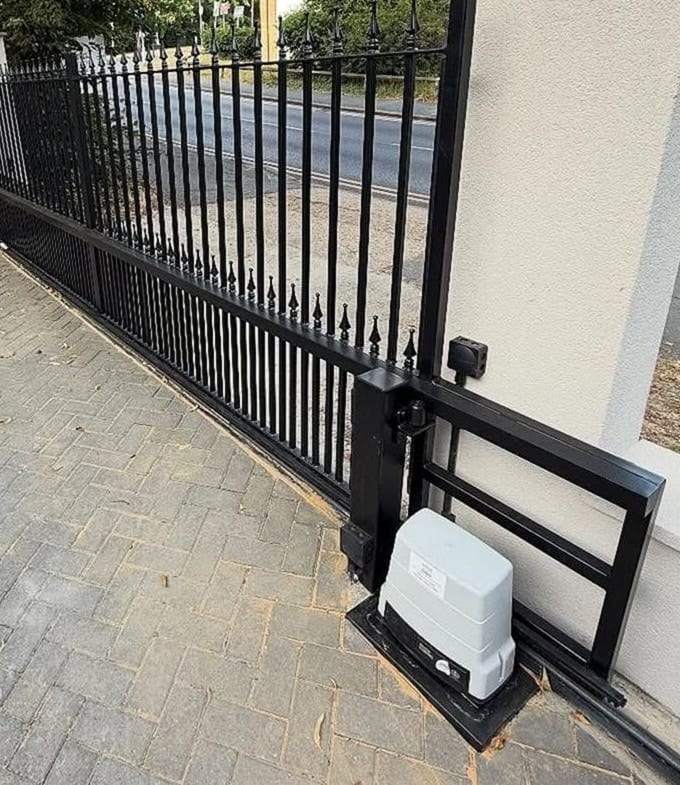
A slide operator sits on its own concrete pad beside the opening and drives the gate along a toothed rack. The pad has to be level and square to the gate, the rack set at the right height along the whole run, and the stops placed so the gate never runs off its track. On a slide gate the photo eyes go across the opening and, where the gate passes a fence or wall as it opens, along that side too.
In winter the same operator has to push the gate through whatever is in the track, so keeping the track clear matters as much as the motor’s size.
Opener Questions
Can you replace an old opener without replacing the gate?
Usually. The gate is checked first: it should swing or roll freely by hand, with sound posts and hinges or rollers. A new operator on a stiff gate wears out early. Mounting brackets, wiring and safety sensors are matched to the new unit, and older openers often get photo eyes they never had.
Will our old remotes work with a new opener?
Sometimes. Remotes have to match the receiver’s brand and frequency, and many older remotes use codes that newer receivers do not accept. A separate receiver can sometimes keep a set of existing remotes working; otherwise new remotes are programmed with the new operator.
What happens when the power goes out?
An operator with a battery backup keeps running for a number of cycles on the battery. Without one, or once it runs down, the gate is opened with the manual release. Cold weather shortens battery life, so a backup battery that is several years old deserves a test each fall.
Opener stalling, reversing or not answering the remote? Call and tell us the symptoms.