
Commercial and HOA Gates
Gates and access control for associations, apartment communities and small commercial sites in and around Bloomington.
A gate at an association or a business opens far more often than one at a house, for far more people. That changes what wears out, how access is managed and how much a breakdown costs. We work for associations and small commercial sites as well as homeowners, on the same gates, operators and access devices.
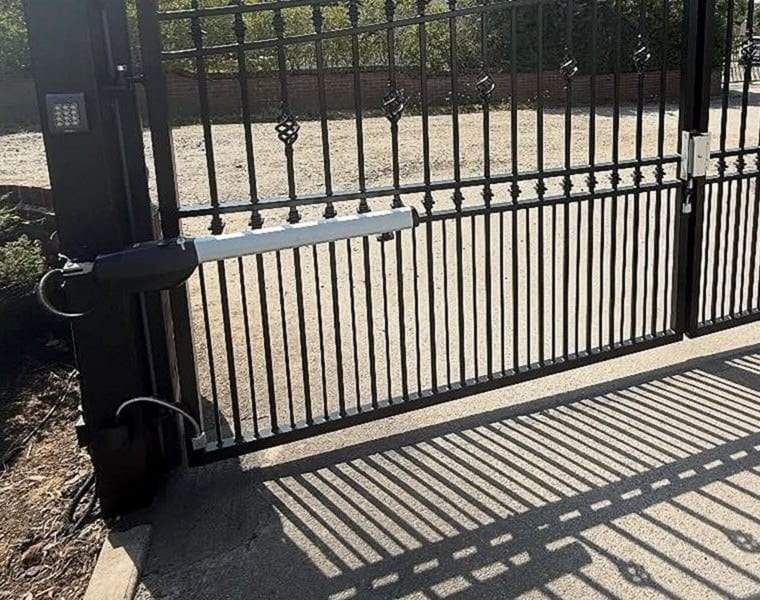
Gates by Property Type
| Property type | Typical gate or access need | Common issues | Suggested service |
|---|---|---|---|
| Homeowner association | A shared entry gate with remotes, a keypad or an intercom | Lost remotes, shared codes, heavy daily use | Access control review and scheduled maintenance |
| Apartment community | Vehicle gates with resident credentials and visitor entry | Tailgating, worn operators, exit loops cut by plows | Operator service, intercom and loop repair |
| Office or small business | A drive gate that opens for staff and closes after hours | Timers out of step, keypads exposed to weather | Access control and opener service |
| Small warehouse or yard | A slide or cantilever gate for trucks and deliveries | Impact damage, bent tracks, heavy gates on light operators | Repair, heavy-duty operators, damage prevention |
| Parking area | A barrier arm or slide gate at the entrance | Constant cycling, broken arms, sensor faults | Sensor and operator service |
A Checklist for Property Managers
Before planning work on a shared entry, gather the answers to these:
- The number of vehicle and pedestrian entries, and which are automated.
- How tenants or residents get in: remotes, codes, cards or fobs.
- How visitors and deliveries get in, and at what hours.
- Emergency access: the key switch or siren sensor the fire department expects.
- After-hours entry: who can open the gate, and how, when the office is closed.
- Existing equipment: operator makes and ages, keypads, intercoms, loops and their records.
Managing Resident Remotes and Credentials
Remotes and codes drift over time. People move out with their remotes, codes get shared with friends and delivery drivers, and nobody knows how many are in use. A simple log helps: who holds each remote or card, which code belongs to which unit, and when they were issued. Codes can be changed on a schedule and when a resident leaves; card and fob systems can cancel a single credential without touching the rest. When the list is out of hand, it is often easier to reset the receiver and reissue remotes to current residents.
Scheduled Inspections and Repair Coordination
A busy gate is better served by visits on a schedule than by calls after it fails. A typical plan checks each gate before winter and again after the spring thaw: hardware lubricated, travel and limits adjusted, safety sensors tested, posts tightened and tracks cleared. Findings go into one list for the whole property, so repairs on several gates can be grouped into one visit and the board or owner can approve them together.
Multi-Gate Property Questions
Can you look after every gate on a property with several entries?
Yes. We work for associations and small commercial sites as well as homeowners. With several entries it helps to keep a record for each gate: what it is, its operator, its access devices and what was done at each visit, so repairs can be planned across the year instead of one breakdown at a time.
Who should be our contact for gate service?
One person, usually the property manager or a board member, with authority to approve work. Residents can report problems to that person, who passes them on with the gate location and what it is doing.
Can repairs be scheduled to keep the entry open?
Most repairs can be planned so the gate is out of service for as short a time as possible, and a gate can often be left open or opened by hand while parts are on order. Tell us how the entry is used when you call.
Managing a gated property? Call to talk through the entries, or schedule a visit.